
Role of Identification
Gurdjieff defined “identification” (or “identifying”) as the involuntary, mechanical fusion of one’s attention with thoughts, emotions, sensations, or external objects, causing a complete loss of self. In this state, a person becomes what they observe, becoming “glued” to their immediate experiences or self-image, which keeps them in a state of deep sleep and hinders self-remembering.
Key Aspects of Identification in Gurdjieff’s Teaching:
- The Default State: Identification is not occasional; it is a near-constant, automatic state where more than half of a person’s life is spent being “absorbed” by whatever captures their interest.

- Loss of Self: When identified, one forgets oneself, leading to a loss of awareness and a reduced ability to control actions.
- The Chief Obstacle: Gurdjieff viewed identification as the main barrier to awakening and “self-remembering.” It is considered the most potent force keeping people asleep.
- Examples: Being completely absorbed by a movie, losing oneself in anger, clinging to an opinion, or becoming totally identified with one’s professional or personal image.
- Freedom from Identification: Gurdjieff taught that “freedom is first of all freedom from identification.” This requires developing the capacity to observe without merging, allowing for true consciousness.


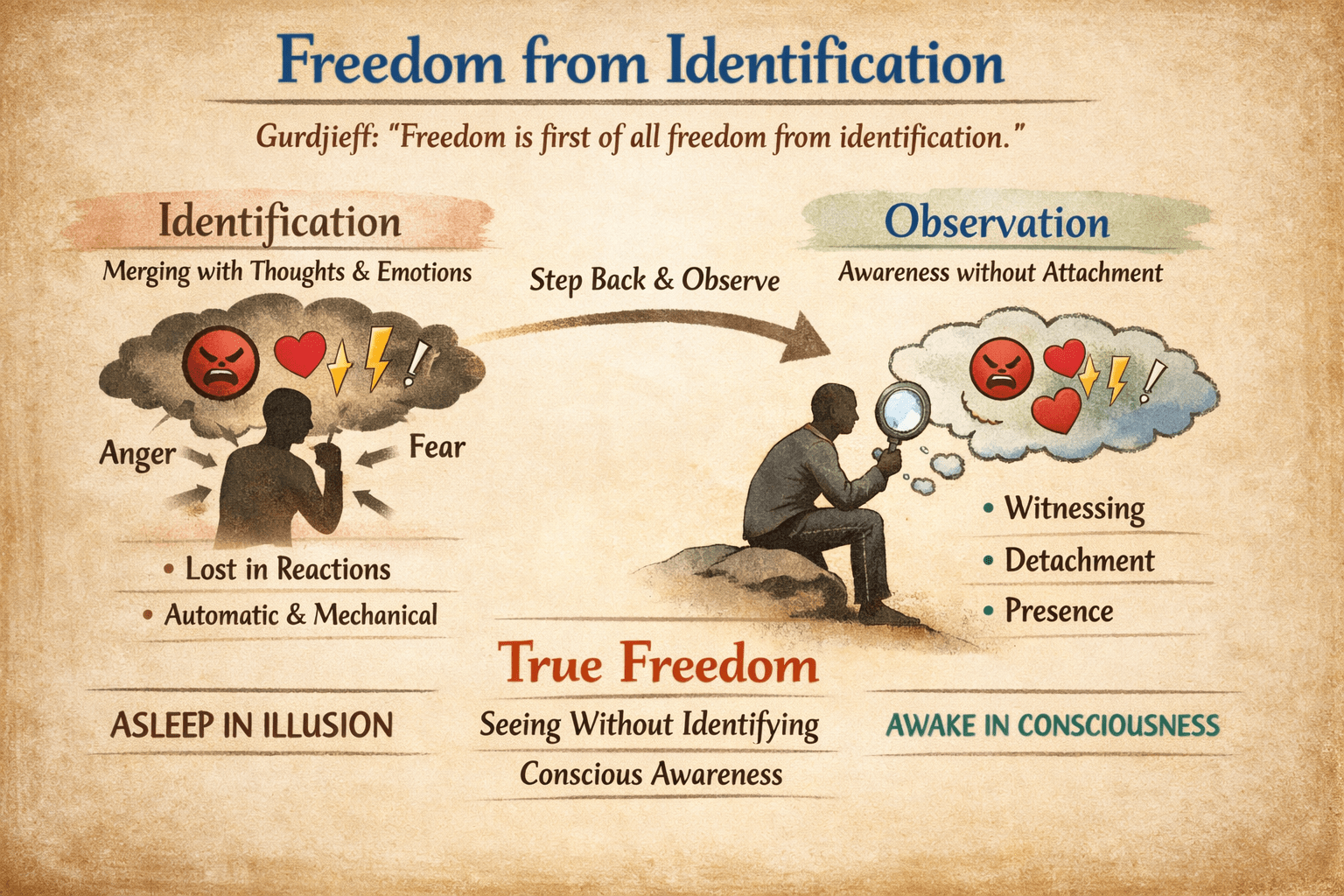
In G.I. Gurdjieff’s Fourth Way teaching, identification (or identifying) is a state of complete, involuntary absorption in whatever has captured one’s attention. It is considered a form of “waking sleep” and is the primary obstacle to self-remembering.
When you are identified, your sense of “I” is lost in an object, a thought, an emotion, or a situation. As Gurdjieff famously put it, in this state, “of yourself nothing remains”—you effectively become the thing you are observing.
Key Characteristics of Identification
- Total Absorption: It is an “involuntary fusion” where you cannot separate yourself from the idea or feeling that has absorbed you.
- Mechanical Nature: It happens automatically and without your consent. It is the “default state” of human existence.
- Loss of Freedom: Gurdjieff taught that so long as a person is identified, they are a “slave” to their circumstances and reactions.
- Flattering Names: People often fail to recognize identification because they value it under names like “enthusiasm,” “passion,” “zeal,” or “spontaneity”.
Common Forms of Identification
- Internal Considering: A specific, pervasive form of identification where one is preoccupied with how others perceive them, whether they are valued enough, or how they are being treated.
- Negative Emotions: Being entirely “taken over” by anger, self-pity, or worry. In this state, you do not just feel the emotion; you are the emotion.
- Physical and Verbal: Identifying with one’s possessions (e.g., “my car”), one’s words during an argument, or even physical sensations like pain.
The Antidote: Non-Identification
The struggle against identification involves self-observation and divided attention. Instead of letting attention flow entirely outward toward an object (a single arrow:), one tries to direct attention both toward the object and back toward oneself simultaneously (a double-headed arrow:).
This practice of “non-identification” does not mean being cold or indifferent; rather, it means having an experience without being swallowed by it, maintaining a part of oneself that remains an impartial observer.